All
You Ever Wanted to Know About The Hulk...
Wednesday,
April 9 2003
Posted
on Newsarama
The following was originally posted on Newsarama:
 Remember
exactly what happened in Uncanny X-Men #285? What about Incredible
Hulk #341? Fanboy memories are going to get upgrades in May and June with
the release of The Comic Buyer's Guide to the X-Men and The Comic
Buyer's Guide to the Hulk - two massive volumes that cover the specifics
of hundreds of issues.
Remember
exactly what happened in Uncanny X-Men #285? What about Incredible
Hulk #341? Fanboy memories are going to get upgrades in May and June with
the release of The Comic Buyer's Guide to the X-Men and The Comic
Buyer's Guide to the Hulk - two massive volumes that cover the specifics
of hundreds of issues.
The cold, bare facts first - The Comics Buyer's Guide to The X-Men, ships
in early May, and The Comics Buyer's Guide to The Hulk, ships in mid-June.
Each volume is 132 pages, full color, comic-sized and squarebound. The Guides
retail for $9.95 each, and each cover more than 750 issues.
Project editor John Jackson Miller gave a rundown of what is included in each:
The Comics Buyer's Guide to the X-Men completely covers many major series
with 'X-Men' in the title, including:
X-Men (1st Series)/Uncanny X-Men, plus annuals
X-Men (2nd Series)/New X-Men, plus annuals
X-Men Unlimited
Ultimate X-Men
X-Men: Hidden Years
X-Men Adventures
"It also includes a variety of limited series, ranging from Children of the
Atom and X-Men Forever to the cross-over books like FF vs. the
X-Men and X-Men/Micronauts. There are certainly more spinoff titles,"
Miller said, "but this is the chunk we bit off for this time."
On the Hulk front:
The Comics Buyer's Guide to the Hulk completely covers:
Incredible Hulk (1st Series)
Incredible Hulk (2nd Series)
The Hulk portions of Tales to Astonish
Rampaging Hulk (the magazine)
Savage She-Hulk
The Defenders (both volumes)
"As with the X-Men guide, we've also included a variety of limited series and
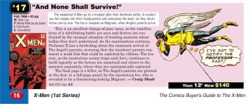
spinoffs," Miller said. In both volumes, each issue entry has its own cover
image."
 The
idea for the Guides grew from another book from Comic Buyer's Guide/Krause,
The Standard Catalog of Comic Books, a 1,240 page doorstop of a book
which lists information on over 145,000 comics. While the Standard Catalog
is arguably one of the best reference books on comics to hit the industry in
a while, the guts of the Catalog, that is, the database used to produce
it, is a goldmine for CBG. Having all the information in an easily accessible
format makes it easy, according to Miller, to develop and publish books such
as the Guides that are much more specialized in nature.
The
idea for the Guides grew from another book from Comic Buyer's Guide/Krause,
The Standard Catalog of Comic Books, a 1,240 page doorstop of a book
which lists information on over 145,000 comics. While the Standard Catalog
is arguably one of the best reference books on comics to hit the industry in
a while, the guts of the Catalog, that is, the database used to produce
it, is a goldmine for CBG. Having all the information in an easily accessible
format makes it easy, according to Miller, to develop and publish books such
as the Guides that are much more specialized in nature.
"We realized we had the capacity to index far more information than simply the
who-did-what and what-character-appeared-where kind of thing," Miller said.
"When we sold out of the first edition of The Standard Catalog so quickly,
we also realized there was strong demand for reference guides that people would
actually read -- as that edition had more than 2,200 series descriptions and
reviews.
"The Comics Buyer's Guide to..." basically takes things to another, deeper
level, evaluating not just the series overall, but the individual issues. And
then we also provide the creator rosters, the publication information, the current
market values, data on the best CGC copy, etc., for everything, all in one place.
"The ideal, of course, is to be able to do everything one day -- and we would
like to work toward that both with the special editions, which obviously will
focus on series in the public eye, and the 'Retroview' feature in CBG,
which allows us to get at lesser-known material, for example, we have The
Inferior Five coming up soon in CBG. Of course, at the size of the
X-Men and Hulk books, doing everything would give us a series of volumes 23,000
pages long.it's a massive potential we're looking at."
 Building
upon what was included in the series' descriptions in The Standard Catalog,
The Comic Buyer's Guides feature a full creator lineup, story title,
page count, issue synopsis and capsule review for every issue. While
a compromise in format, as many other variables cold have been listed issue
by issue, this manner of putting the Guides together did have its benefits,
Miller noted.
Building
upon what was included in the series' descriptions in The Standard Catalog,
The Comic Buyer's Guides feature a full creator lineup, story title,
page count, issue synopsis and capsule review for every issue. While
a compromise in format, as many other variables cold have been listed issue
by issue, this manner of putting the Guides together did have its benefits,
Miller noted.
"It's interesting to see that this format really does have a way of helping
the reader identify recurrent themes and familiar devices in a series," Miller
said. "Memory may fail, but the The Comics Buyer's Guide to the X-Men
reminds you of just how many 'Kitty Pryde fights an alien' issues there actually
were. And then there are other matters reviewers noted, such as how the switch
at Marvel from 17-page stories to 22-page stories in 1980 seems to have contributed
to the concurrent rise in the X-Men's popularity.
"We don't go into the level of detail George Olshevsky went into in the old
days when it comes to continuity - 'this character next appears in...' -- that
sort of thing. That information's utility to the average fan is probably not
what it once was. But I will say that, just proofreading, I've remembered far
more stories and characters than I would ever have imagined reading. Lila Cheney
dropped totally out of my grey matter years ago, and The Comics Buyer's Guide
to The X-Men brought her right back."
As with all reviews, those included in The Comic Buyer's Guides are subjective,
and may raise the ire of readers who feel strongly about certain issues, but
according to Miller, they give the Guides a more personal feel than a
simple list of issues - and reading them is infectious.
"The reviews make for great reading, even if -- I should say, especially if
-- you've read the comics before!" Miller said. "One whole section of CBG
each week is already devoted to people discussing the comics of the past, and
this gives those readers a healthy dose. It's hard to stop reading these, once
you've started.
"Beyond that, of course, we're the Comics Buyer's Guide, so obviously
we're a guide to buyers of comics. Magazines such as CBG quite adequately
evaluate issues on the stands today, but there really hasn't been any way of
archiving those evaluations. With a home for that material in our database,
we'll be able to make information generated today available in a variety of
configurations for years to come.
"And again, review material was something that hadn't ever really been a part
of previous indexes. While they were interesting as references tools, we think
adding reviews -- by specialists such as Craig Shutt, Jim Johnson, Jack Abramowitz,
and Steven George to name a few, makes the package much more interesting."
Speaking to the veracity of the data in the volume, Miller explained that each
contributor was assigned a chunk of issues, and they then had to fill in all
the blanks regarding the issue, in addition to writing a synopsis and review.
As such, every issue entry has been examined by hand, leading to a higher degree
of accuracy than just a database where bulk issue descriptions are updated.
As a matter of fact, the data coming in from contributors has allowed Miller
to make corrections to the original database.
Miller also cited several factoids that came to light as a result of contributors
specialized knowledge, or just the close examination of the issues, such as
Shutt's notes that Werner Roth signed as Jay Gavin, the two variant editions
of the Marvel Mart catalog in X-Men Adventures Vol. 2, #4, and the apparent
inability of the credit box to spell Marc Silvestri's name consistently (Marc
vs. Mark) in the issues of his run.
Each issue will also have a value listed as well - something Miller has utter
confidence in. "And certainly our aftermarket pricing - which depends on actual
transactions -- remains the most accurate in comics," Miller said.
 Given
the timing of the Guides releases, both are receiving attention from
the direct market and bookstores, according to Miller. And while the volumes
are relatively specialized in their content and one would assume receive the
warmest reception in comic shops, bookstores are warmed to the idea of the Guides
as well, due to the strong showing The Standard Catalog of Comics had
last year. For a $35 book racked in the hobby section, The Standard Catalog
sold well in the bookstore market.
Given
the timing of the Guides releases, both are receiving attention from
the direct market and bookstores, according to Miller. And while the volumes
are relatively specialized in their content and one would assume receive the
warmest reception in comic shops, bookstores are warmed to the idea of the Guides
as well, due to the strong showing The Standard Catalog of Comics had
last year. For a $35 book racked in the hobby section, The Standard Catalog
sold well in the bookstore market.
"There's clearly interest in both of these editions," Miller said. Although
I should point out that Diamond erroneously gave The Comics Buyer's Guide
to the X-Men a four-digit issue number in its Previews listing, which
may have given it the appearance of just another issue of CBG -- but
it certainly isn't that! This is a completely separate animal, available to
CBG subscribers and non-subscribers alike."
Of course, these two volumes are only the start. Given the relative ease at
which the Guides can be produced, more are on the way - and while Spider-Man
is probably a no brainer for next year, Miller said that future volumes won't
necessarily be character or property-specific.
"I have a large number of proposals on the table, and not ones simply
tied to specific characters, either -- or even super-heroes," Miller said. "I
think what we have here is a very flexible format that will allow us to address
a wide variety of comics over the years. Some will be big productions aimed
at a wide audience, like these; others will be targeted at specific audiences.
It's certainly not like we're going to run out of comics!"
Retailers can still order The Comics Buyer's Guide to The X-Men and The Comics
Buyer's Guide to The Hulk from Diamond or directly from Krause Publications
at (800) 894-4656. The Diamond codes are MAR032549 and APR032570 respectively.
Disclosure: Matt Brady contributed to the X-Men volume.
Wanna
talk about this bit of news? Start a discussion over at the boards.
Check
out the fan trailer here.
News |
Archive | Boards
| Cast | Multimedia
Trailers
| Contest | Links
| About | Store
| FAQ
This is an
unofficial fan site and is in no way affiliated with the production of the
movie, and all pictures and other material are not intended to infringe on
any copyrights owned by Universal Pictures and Marvel Comics. All original
content & design Copyright © 2007 GammaStorm.com


 Given
the timing of the Guides releases, both are receiving attention from
the direct market and bookstores, according to Miller. And while the volumes
are relatively specialized in their content and one would assume receive the
warmest reception in comic shops, bookstores are warmed to the idea of the Guides
as well, due to the strong showing The Standard Catalog of Comics had
last year. For a $35 book racked in the hobby section, The Standard Catalog
sold well in the bookstore market.
Given
the timing of the Guides releases, both are receiving attention from
the direct market and bookstores, according to Miller. And while the volumes
are relatively specialized in their content and one would assume receive the
warmest reception in comic shops, bookstores are warmed to the idea of the Guides
as well, due to the strong showing The Standard Catalog of Comics had
last year. For a $35 book racked in the hobby section, The Standard Catalog
sold well in the bookstore market. 


